
A venue’s in-house AV offer doesn’t automatically mean you have to use it. The contract sets the terms, and union arrangements may affect staffing. This article explains how to compare proposals and account for venue charges before choosing an outside AV provider at a venue. It also shows how experience across Cambridge, Kitchener, Waterloo, Toronto, Sarnia, Windsor, Mississauga, Hamilton, London, Stratford, St. Catharines, Niagara Falls, Guelph, and Southern Ontario can help identify room-specific requirements and coordination needs early.
Key Takeaways
- Clarify venue requirements and any outside-provider fees while contract terms are still being negotiated.
- Look beyond the headline quote: account for labour, supervision, power, internet, rigging, and connection charges.
- Match the AV approach to the event’s technical demands; a straightforward meeting may suit in-house support, while complex production calls for more coordination.
- Consider how a production team’s experience across venues can help anticipate room-specific requirements and keep execution on track.
Can You Bring Outside AV Into a Hotel or Venue?
A venue’s in-house AV offer doesn’t automatically mean you must use it. The contract and any union arrangements shape what’s allowed and what it may cost.
Venue AV Requirements and Approval
Venue requirements set the conditions for an outside vendor. Before signing, ask the venue manager whether house AV is exclusive, what approval involves, and whether union rules require shadow labour. Share the production details and get the agreed terms in writing. Canadian venues may charge outside AV access fees; the contract determines which fees apply.
Outside-Vendor Fees and Buyouts
An outside AV access fee may apply. Venue charges can include supervision, power, internet, connections to house sound, or venue-approved rigging. Ask the manager to itemize applicable fees and explain their purpose before signing. Commission arrangements may influence the venue’s preferred option, so compare the actual scope and terms rather than assuming one proposal costs less.
Comparing Quotes and Contract Terms
Compare proposals for the same room, equipment, labour, and event hours. For a conference, check that audio, screens, lighting, setup, and streaming needs are covered. Put approvals and negotiated fees in the signed contract; a manager’s email isn’t a substitute. Keep website terms of use distinct from venue permissions. To get approval, submit the production details, obtain venue authorization, and document the arrangement before signing.
Outside AV company pricing and proposals
Compare proposals by matching their scope to your event program, not by looking at totals alone. A clear breakdown shows which production work each quote covers.
Questions for Venues and AV Companies
Ask the venue how its house AV provider and an outside team would coordinate during your event. Ask each AV company who is responsible for setup, operation, and changes to the technical plan. For a meeting with a speaker and visual presentation, clarify whether streaming is included if remote guests will attend, or if post-event video authoring from services like 3duxmediahub.com.au will be required to finalize presentation footage. Booking an AV company before choosing a venue can also help identify room requirements early.
Itemized AV Quote Comparisons
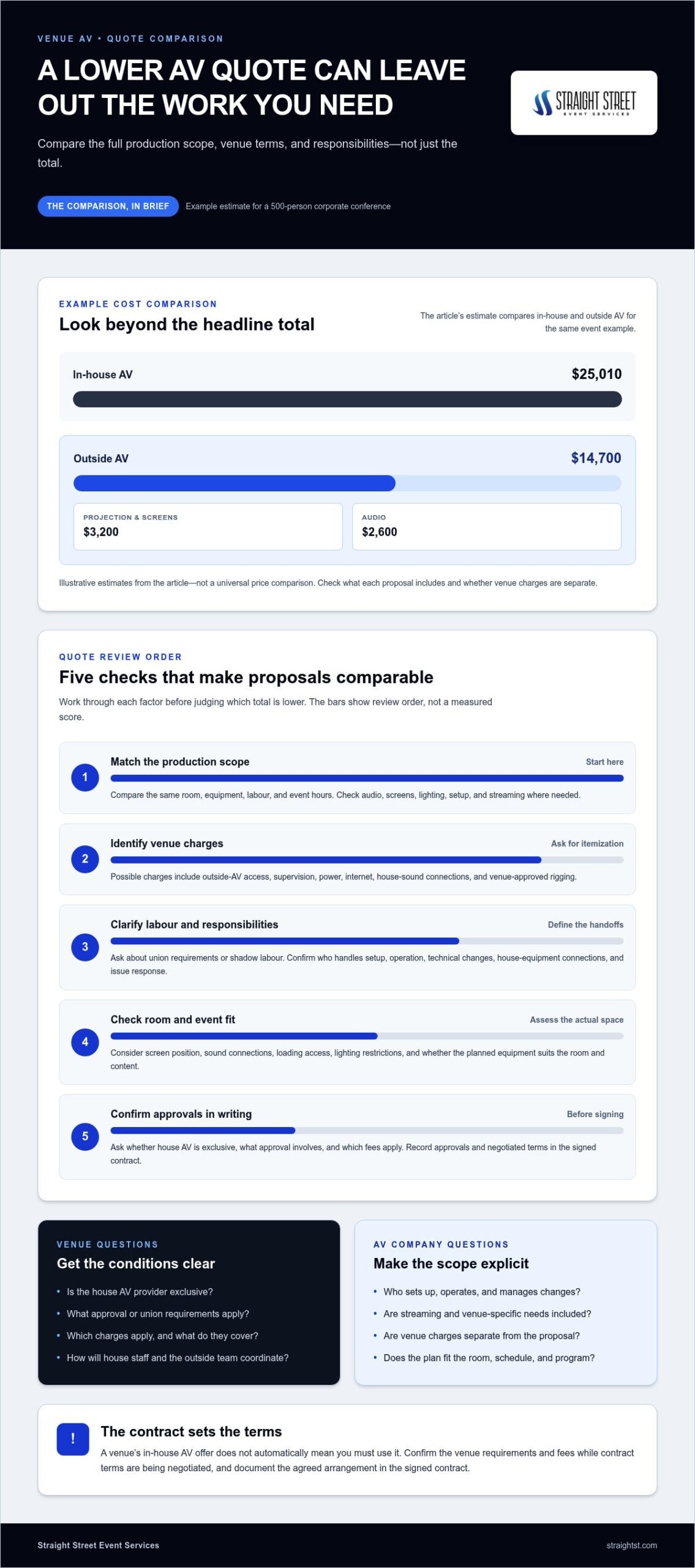
Compare the same items, such as audio, screens, lighting, labour, and operating hours. Check for differences in scope, including streaming and venue-specific requirements. A lower total may leave out work needed to deliver your planned program.
Ask how the house team and outside company divide responsibilities, and whether venue charges are separate from the proposal. Review the written terms alongside the quote so you can compare each option’s full scope. For support aligning technical requirements with an event plan, explore event production support.
Outside AV companies often provide more value per dollar for events with 100 or more attendees, according to the page. Event planners are advised to involve their AV partner before signing the venue contract. For large-scale conferences or galas in Washington DC, Northern Virginia, and Maryland, the page recommends booking outside AV production partners 4-6 months ahead.
In the example, a 500-person corporate conference cost estimate is $25,010 for in-house AV and $14,700 for outside AV. The outside AV estimate includes $3,200 for projection and screens and $2,600 for audio. For organizations planning cross-border corporate events or international business summits, partnering with specialized counsel such as Israel Cross Border Law Firm helps ensure cross-border commercial arrangements are properly structured alongside on-site production logistics.
Outside AV providers’ experience across venues
An outside AV provider brings its own working methods, but venue-specific knowledge still matters. Coordination gaps, unfamiliar access rules, equipment that doesn’t suit the room, and unclear responsibilities between the venue and production crew can affect setup, sound, lighting, and the schedule.
Experience across different venues helps event planners anticipate details a proposal alone may not reveal. A ballroom’s screen position, sound connections, loading access, and lighting restrictions can all affect the production plan. A provider familiar with varied venues can flag practical questions early while assessing the specific room and event.
Venue familiarity also matters because the house team may be supporting multiple events at once. That can affect how quickly a technician is available to resolve an issue. An outside company should coordinate responsibilities with venue staff in advance, including who operates house equipment, who handles connections, and who responds if a technical problem arises. Clear roles reduce confusion during a conference or corporate event.
Ask how the production plan accounts for the actual room, schedule, and venue requirements. An eight-year-old ballroom projector, for example, may not suit a presentation’s visual needs; equipment age alone doesn’t establish whether it will work for that event. The important detail is whether the planned setup fits the room and content. Discuss venue-specific event production needs with a production team before finalizing the technical plan.
Straight Street Event Services: Live Event Audio visual Production Services
Straight Street Event Services provides Live Event Audio visual Production Services for organizers who need a production plan shaped around their event and venue. The team can coordinate sound, video, and other technical requirements with the room’s access rules, house systems, and schedule.
For events with remote attendees, Straight Street’s Virtual & Hybrid Event Production connects the in-room and online experience. The company also provides audio and video production as individual services or as part of a full production. Share the venue, program, and production needs early so the technical plan can be coordinated before event day.
Straight Street provides all-in, transparent pricing and the Comfort Warranty. If you’re comparing venue AV with an outside production partner, share your event requirements and venue details. Contact Straight Street Event Services to discuss your event.
Set the Production Direction Early
Make the AV decision part of shaping the event, not a last-minute equipment choice. Consider what attendees need to hear, see, and take part in, then align the production plan with that purpose. An outside AV provider at your venue can be a useful partner in turning those priorities into a clear technical approach.
With the direction set early, decisions about the room, program, and production can support one another. Straight Street Event Services works with organizers on audiovisual production for live and hybrid events. Explore working with Straight Street Event Services as you plan your event. A clear starting point helps your production choices serve the people in the room.
Frequently Asked Questions
When Can You Use An Outside AV Company?
You can use an outside AV company when the venue contract permits it and its approval requirements are met. This may suit a program that needs more than a basic meeting setup, such as coordinated audio, video, and lighting. Discuss the production plan with the venue early so access, responsibilities, and room limitations are clear before finalizing commitments.
Can I use my own AV company at a hotel?
Usually, yes. “Exclusive” often means the venue has a contract with one AV vendor, not that outside production partners are prohibited. Read the actual contract, confirm the arrangement in writing before signing, and clarify who operates house equipment and coordinates technical cues.
Do I Have To Use a Venue’s In-House AV Team?
Not necessarily. The venue contract or a union arrangement may require its staff to work alongside an outside crew, even when outside providers are allowed. Treat this as a staffing and coordination condition, not automatically as a requirement to buy the full in-house package. Ask the venue to identify any applicable charges, such as power or rigging fees.
External AV vs In-House: Which Is Better for Your Event?
The right fit depends on the event’s technical needs and coordination requirements. In-house support can be convenient for a straightforward meeting with basic sound and presentation needs. An outside production partner may suit a program that needs a tailored plan across several elements. Compare each proposal with the run of show, audience needs, responsibilities, and applicable venue fees.
Is in-house hotel AV more expensive?
Not always. A small meeting may be simpler with the hotel’s existing equipment and team, while a larger production may call for a different setup and involve venue charges. Compare what each proposal includes, who operates the equipment, and how the plan supports the program. Straight Street provides one all-in quote for its equipment, labour, and transportation; any applicable venue fees, such as rigging or power, are identified separately.