
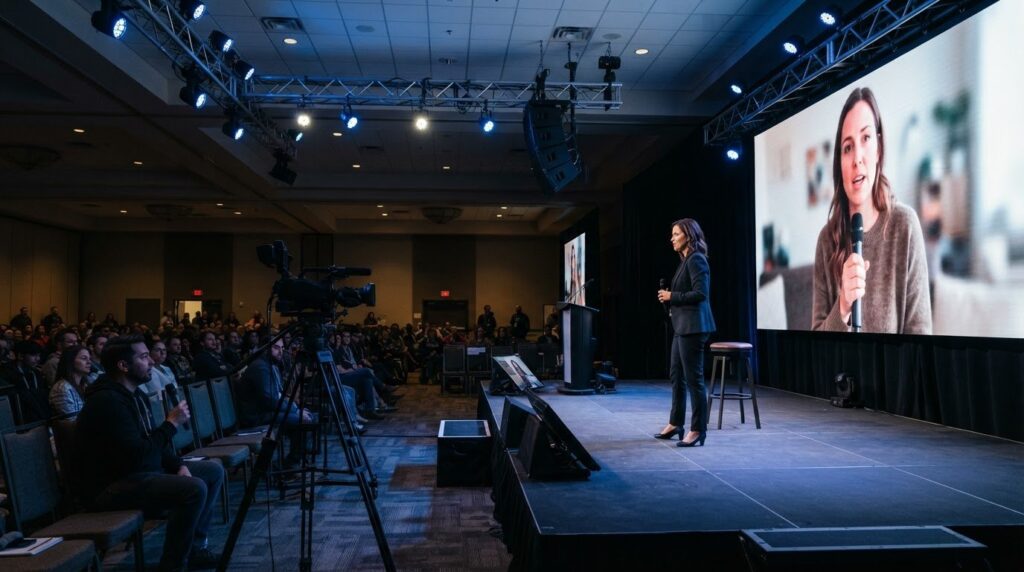
A camera alone cannot make an event work for remote attendees. Hybrid event production in Ontario connects the room and online audience with clear sound, reliable video and coordinated timing.
That takes more than a livestream. Both audiences need ways to follow the programme and participate.
Learn what defines a hybrid event, how to plan for in-person and virtual access, and what production support can bring the two together.
Key Takeaways
- Plan for remote and in-room guests as two audiences who need clear access to the same programme.
- Build participation into the event with planned ways for online attendees to ask questions and connect.
- Coordinate the schedule, technical setup and rehearsal so production supports the event from start to finish.
- Match audio, video and other production needs to the venue, audience and event purpose.
Accessibility for onsite and virtual attendees
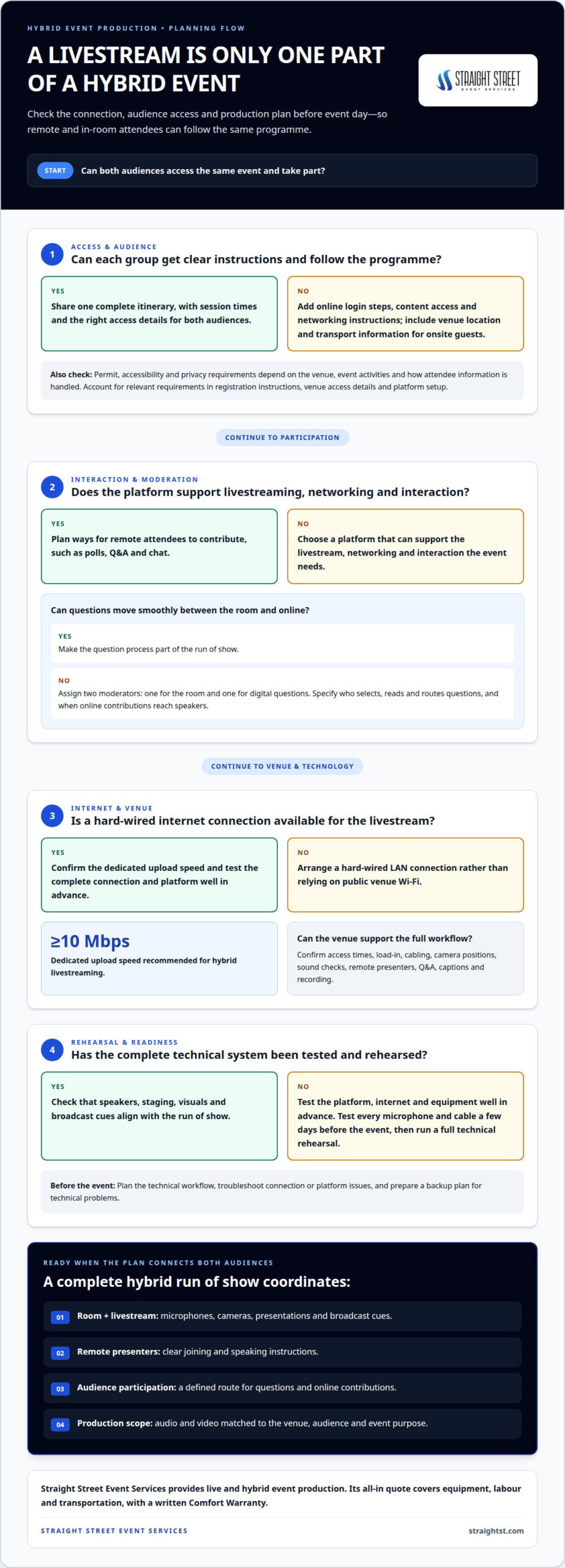
Accessibility starts with clear access information for both audiences. Send virtual attendees login steps, content access details and online networking instructions; give onsite guests the venue location and transport information. Share one complete itinerary so everyone can follow the same programme and know when sessions begin.
Permit, accessibility and privacy requirements depend on the venue, event activities and how attendee information is handled. Identify the relevant requirements during planning, then account for them in registration instructions, venue access details and platform setup.
Choose a virtual event platform that supports livestreaming, networking and interaction. Use polls, Q&A and chat to engage remote attendees, and assign two moderators: one for the room and one for digital questions. A run of show should identify who selects, reads and routes questions, so online contributions reach speakers at the right time.
Separate onsite costs, such as the venue, food and signage, from virtual needs, such as platform software and production. This makes trade-offs clear before decisions are finalized. For example, a smaller in-room setup may still need dedicated video production to serve remote viewers.
Promote both ways to attend through email and social media, with separate instructions for joining online or arriving onsite. A useful starting point for planning the virtual production is the hybrid event production services information, which outlines support for events serving both audiences.
What is a Hybrid Event?
A hybrid event combines in-person attendance with remote access. Its production plan coordinates the room, livestream and opportunities for both audiences to participate.
Technical Infrastructure and Remote Interaction
For a corporate conference, production connects microphones, cameras, presentations and the livestream. Give remote presenters clear instructions for joining and speaking. Plan how online questions will reach speakers and how captions or recordings will be incorporated into the broadcast. These decisions shape the technical run of show and help keep the conference organized for audiences in the room and online.
Venue and Internet Requirements
Ontario organizers should arrange a hard-wired LAN connection rather than rely on public venue Wi-Fi. A dedicated upload speed of at least 10 mbps is recommended for hybrid livestreaming. At a Cambridge venue, coordinate load-in, cabling, camera positions, sound checks and rehearsal with venue access times. Confirm the venue can support remote presenters, Q&A, captions and recording.
Plan the technical workflow before event day, then test the complete system. Test the platform, internet connection and equipment well in advance; troubleshoot slow connections or platform glitches before attendees arrive. Test every microphone and cable a few days before the event, then run a full technical rehearsal. This aligns speakers, staging, visuals and broadcast cues.
That coordination matters: hybrid event production support connects venue logistics with the remote experience instead of treating the livestream as an add-on.
Careful planning, thorough testing, a backup plan for technical issues and experienced event professionals help keep a hybrid event running smoothly and support moderation and contingency needs.
Hybrid event production across Ontario
Hybrid production connects the in-person event with streaming, platform access and technical support for remote attendees. Across Ontario, the production team’s location and travel plan matter alongside equipment, venue access and the schedule.
Hybrid Production Providers
Ontario events are produced by audiovisual teams that coordinate the in-room setup with the broadcast and remote participation. A production plan should make responsibilities clear for technical cues and responding to issues. RevenueBase recorded 99 Toronto hybrid event production companies with 1-10 employees, 19 with 11-50 employees and 6 with 51-200 employees on Sep 20, 2026. Those counts describe Toronto, not the province as a whole.
Ontario Service Areas
Straight Street Event Services supports events in Cambridge, Kitchener, Waterloo, Toronto, Mississauga, Hamilton and Guelph, as well as London, Stratford, Sarnia, Windsor, St. Catherines and Niagara Falls. For events throughout Southern Ontario, travel, equipment transport and venue access are part of planning the production schedule.
For events drawing attendees from across the province, choose a schedule that suits their locations and participation needs. This regional planning helps connect the in-person event with virtual access, even when attendees are spread across multiple communities.
Planning across the region? Discuss your audiovisual production needs for the event’s venue and audience.
When attendees join from different locations, build the event schedule around their participation needs. Plan for the main hybrid production challenges: technical coordination, balanced engagement for in-person and remote audiences, and smooth coordination between both settings.
A hybrid run of show should assign responsibility for selecting, reading, and routing questions from onsite and online audiences. The assignment covers the question process, including which questions are selected, who reads them, and where they are routed.
Straight Street Event Services: Live Event Audio visual Production Services
Straight Street Event Services provides live and hybrid event production, coordinating technical support for audiences onsite and online. Turn to the team when your event needs sound and video designed around the programme, speakers and audiences, not a camera added at the last minute.
Audio and video production support clear communication between the room and remote attendees. Straight Street provides one all-in quote covering equipment, labour and transportation, along with its written Comfort Warranty.
Planning a hybrid event? Contact Straight Street Event Services to discuss your production needs and request an all-in quote.
Set the Production Plan in Motion
Before committing to a hybrid format, define what remote attendees should be able to see, hear and contribute. This decision shapes the production scope and keeps technical choices tied to the event’s purpose. For hybrid event production in Ontario, start by aligning your goals, venue and audience needs in one workable plan.
Straight Street Event Services provides live and hybrid event production, including audio, video, lighting and staging. The team recommends a production plan suited to the event, venue, audience and budget, rather than starting with an equipment list.
Discuss your event’s production needs with Straight Street Event Services. A clear plan gives both audiences a stronger opportunity to take part.
Frequently Asked Questions
What if something goes wrong at my event?
Before the event, agree on how the team will respond if a cue, presentation file or connection fails. Identify who can approve a schedule change and how speakers will be informed. During the show, experienced operators can adjust the run of show and communicate changes to presenters, moderators and event staff, so decisions stay clear and no one has to improvise alone.
What services do hybrid event production companies in Ontario provide?
Production support can include technical direction, show cues, presenter support and operation during the event. For example, an organization with a remote keynote and in-room panels may need different presenter handoffs and cues than a meeting streaming a single speaker. Define the programme first, then match production roles to it. Straight Street provides experienced operators for every position.
How much does hybrid event production cost in Ontario?
The quote reflects each event’s production requirements rather than a standard rate. A short presentation with one speaker has different needs from a multi-session conference with remote presenters. The venue, programme format and production scope all inform the proposed work. Straight Street provides one all-in quote covering equipment, labour and transportation; standard venue fees, such as rigging or power, may still apply and are identified in the quote.
What factors affect hybrid event production pricing in Ontario?
Programme length, the number of sessions, presenter transitions and remote speakers all help determine the production plan. Room layout also affects camera coverage and setup. A conference with several stages or presentation formats needs a different plan from a single-room meeting. Clear schedules and presentation requirements help define the scope before production decisions are made.
What audio, video, streaming, and internet equipment does a hybrid event need?
The right setup depends on what attendees need to see and hear. A panel may need microphones that capture each speaker, while a presentation may need a clear view of both the presenter and slides. Match camera coverage, playback and streaming to the programme. The production plan brings these elements together instead of relying on a fixed equipment list.