
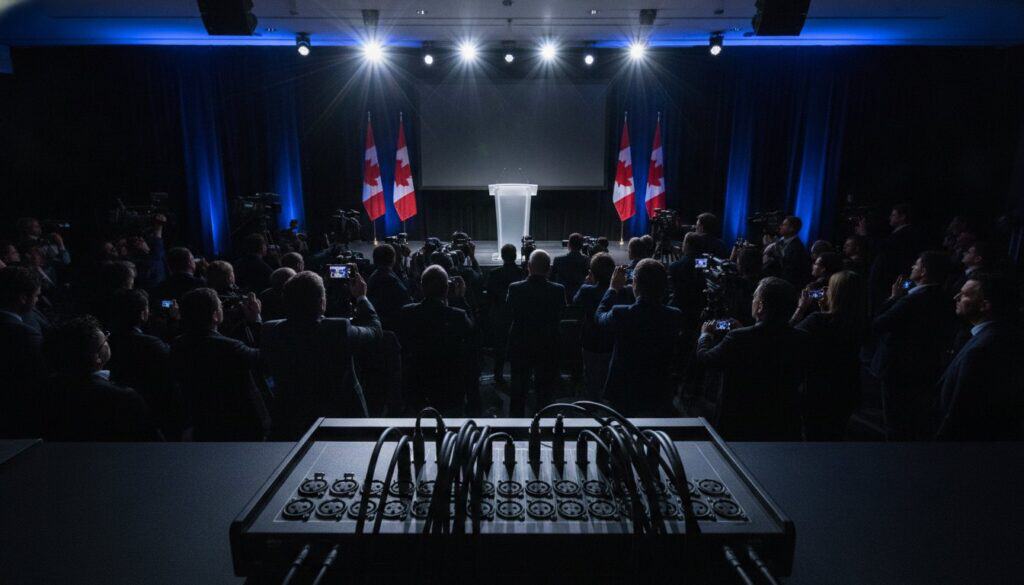
A press conference can fail before a single word is spoken if the media can’t get a clean, reliable signal. For communications professionals, the biggest risk isn’t a tough question—it’s a technical failure that prevents the message from being captured and broadcast clearly. This requires a shift in thinking from simply renting equipment to implementing a technical broadcast strategy.
The Technical Architecture of a Flawless Ontario Press Conference
The foundation of any successful media event is its technical infrastructure. The goal is to provide every news outlet with a perfect audio and video feed, eliminating any possibility of them using poor-quality audio from their on-camera microphones. This is not about volume; it is about signal integrity and distribution.
The Role of the Press Feed in Media Relations
A professional press conference requires a dedicated press feed, also known as a multi-box or press box. This device takes the clean audio signal directly from the main microphone and provides dozens of individual, isolated outputs for journalists to plug into. It is the single most critical piece of audio equipment for a media event.
Relying on journalists to capture “room sound” with their camera mics results in inconsistent, low-quality audio filled with coughs, whispers, and ambient noise. A press feed guarantees that every outlet, from national broadcasters to local bloggers, receives the same crisp, direct audio. We always provide both XLR and 3.5mm outputs to accommodate the full range of professional and consumer-grade cameras.
Broadcast-Quality Audio Standards
The audio needs of a broadcast are different from those of a live audience. The sound system must be tuned to deliver clear, intelligible speech specifically for recording and broadcast, which often means a different approach than just making it loud for the room. This includes using broadcast-grade microphones designed to capture vocal frequencies with exceptional clarity.
To prevent disaster, we build redundancy into our systems. This often means having backup microphones, cables, and even mixers ready to go instantly. For any live broadcast, a single point of failure is unacceptable, and our planning ensures that a technical issue doesn’t become a public one. This commitment is a core part of our Comfort Warranty, ensuring your event is protected.
Mitigating Risk in Southern Ontario’s Fast-Paced Media Environments
From downtown Toronto to smaller city centres like Guelph or Stratford, every venue presents unique logistical challenges. A successful event depends on proactive planning and local knowledge to address potential issues before they arise. This “no surprises” approach is essential for high-stakes announcements.
The Importance of the Pre-Event Site Visit
A site visit is non-negotiable for ensuring a smooth press conference. In dense urban areas like Toronto or Hamilton, we assess for potential radio frequency (RF) interference that could disrupt wireless microphones. We also evaluate the venue’s power capacity to ensure our lighting and audio equipment won’t trip a breaker mid-event—a common but avoidable problem.
Logistics are just as important. We plan load-in routes, especially in historic Southern Ontario buildings with tight access, and coordinate timing to navigate traffic along the Windsor-to-Toronto corridor. This detailed planning ensures our team is set up and has completed sound checks long before the media arrives. Our goal is to make the technical production invisible, which is only possible through meticulous preparation.
Lighting for the Camera, Not Just the Room
Lighting for a broadcast is fundamentally different from lighting a room. The camera sees light in a way the human eye does not, and getting it right is crucial for how your spokesperson is perceived. We use a standard three-point lighting setup to create a professional look, and if you want to ensure your personal grooming is just as sharp before the cameras roll, click here.
We also pay close attention to colour temperature. Mixing the venue’s fluorescent lights with professional LED stage lighting can confuse cameras and result in poor colour balance on screen. By controlling the lighting, we ensure the visual quality of the broadcast matches the professionalism of your message.
Strategic Branding and Visual Impact for Media Announcements
The visual elements of a press conference do more than just fill the space; they frame the entire announcement. A well-designed stage with professional branding ensures your organization’s identity is central to every photograph and video clip. It provides a clean, authoritative backdrop that supports the speaker.
Crafting the Main Camera Shot
Everything should be arranged with the main camera shot in mind. This includes the strategic placement of flags, banners, and digital screens to ensure the brand is consistently visible without cluttering the frame. We use professional staging and scenic elements to create a background that looks clean and intentional, reinforcing the importance of the announcement.
The podium or lectern itself can also be customized to align with the event. Whether it’s a sleek corporate design or a traditional lectern for a government announcement, these details contribute to the overall visual tone. The goal is to create a cohesive look that appears polished and credible on camera.
Managing the Hybrid Press Conference
When journalists are joining remotely, the technical requirements expand. A hybrid press conference needs a system that allows remote reporters to ask questions and be heard clearly by both the speaker and the in-person audience. This requires careful audio routing and a reliable virtual platform.
We ensure the virtual audience receives the same high-quality video and audio feed as the in-person press gallery. This technical parity is key to treating all media members equally and ensuring broad, accurate coverage of your event.
Ultimately, a press conference is a technical production designed for a media audience. By focusing on flawless execution, proactive planning, and transparent, all-in pricing, you can ensure your message is captured exactly as intended. It’s about building a foundation of trust with the media through technical reliability.
Frequently Asked Questions
What is a press feed or multi-box and why do I need one?
A press feed, or multi-box, is a professional audio distribution device. It provides numerous isolated audio outputs, allowing every journalist to plug their camera or recorder directly into the sound system for a clean, broadcast-quality audio signal, free from room noise.
How much lead time is required to set up AV for an Ontario press conference?
While we can accommodate last-minute requests, we recommend at least one to two weeks of lead time. This allows for a proper site visit, logistical planning, and coordination with the venue, which is crucial for a “no surprises” event.
Can you provide lighting suitable for 4K television broadcast?
Yes. We provide professional, flicker-free LED lighting systems with controlled colour temperature, specifically designed to meet the high standards of 4K broadcast and ensure your speakers look their best on camera.
Do you handle media events in smaller Southern Ontario cities like Stratford or Guelph?
Absolutely. Our team is based in Cambridge and regularly provides AV services for press conferences across Southern Ontario, from Windsor and Sarnia to Kitchener-Waterloo, Guelph, Hamilton, and the entire GTA.
What happens if there is a technical failure during a live broadcast?
Our planning process is built around redundancy. We have backup microphones, cables, and other critical components on-site to address any potential issues immediately. This is a key part of our Comfort Warranty and our commitment to a flawless event.
Do you provide teleprompters for press conferences?
Yes, we provide presidential and standard teleprompter systems, complete with an operator, to help speakers deliver their remarks confidently and professionally.