
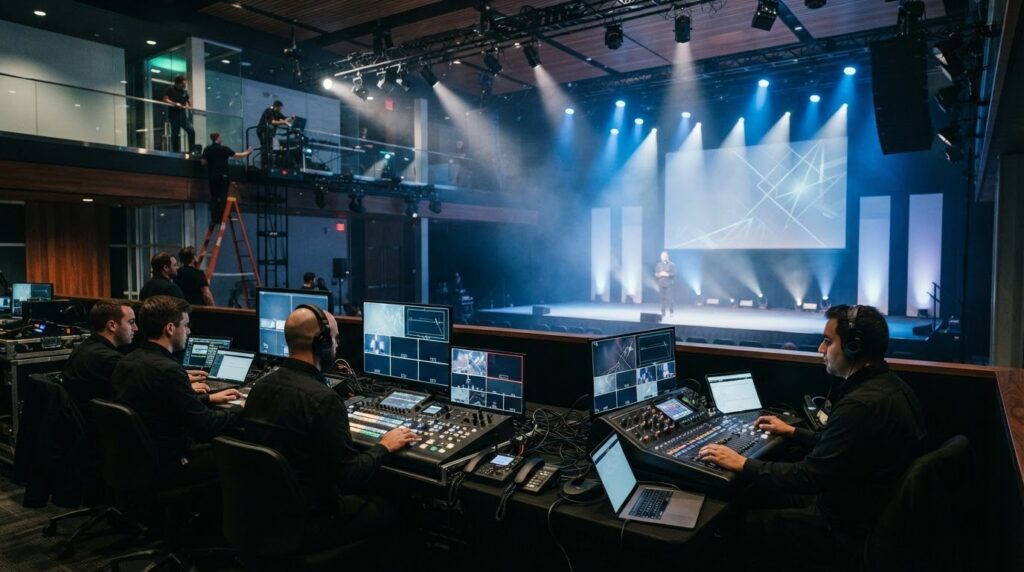
When an event needs several technical elements, equipment rental alone may leave questions about who coordinates them, what support is included, and who responds to issues on show day. That uncertainty can make it harder to set a clear scope before production begins.
The right AV solution depends on the event’s needs, from one production component to coordinated support. This article explains what that support can cover, how planning connects to show-day execution, and how to assess the right scope for events in Cambridge and Southern Ontario.
Key Takeaways
- Understand how full service event AV differs from equipment delivery by connecting production elements with technical direction and on-site support.
- Use early conversations about event goals, venue details, and schedule to define the production scope and surface coordination needs.
- Match the level of production support to your event’s technical requirements, rather than choosing equipment in isolation.
- See how a Cambridge-based production partner can support events across Waterloo Region, the GTA, and Southern Ontario.
What Full-Service Event AV Includes Beyond Equipment Rental
Equipment delivery covers only part of an event’s technical needs. Coordinated production support can bring planning, equipment, technical direction, and on-site technicians together around the event’s purpose, audience, venue, and programme. A presentation may need clear speech and visible slides, while a live performance can call for a different balance of sound, lighting, video, and staging.
Coordination also helps clarify how each production element fits the event as a whole. Rather than treating every item as a separate rental, the team considers how they’ll work together. This is one part of event management, where technical production supports the wider event.
Which production elements work together at an event?
For a live presentation, sound helps the audience hear speakers, video makes presentation content visible, lighting supports visibility in the room, and staging gives speakers a defined place to present. Technical direction connects these elements to the run of show, while on-site technicians manage their operation. The production scope can include only the elements that serve the programme and audience.
Live events serve people attending in person. Virtual and hybrid productions also account for remote attendees, with video and livestream production forming part of the plan. Straight Street’s live event production supports in-person events, while hybrid productions require additional coordination for remote audiences.
How Full-Service Event AV Moves from Planning to Show-Day Execution
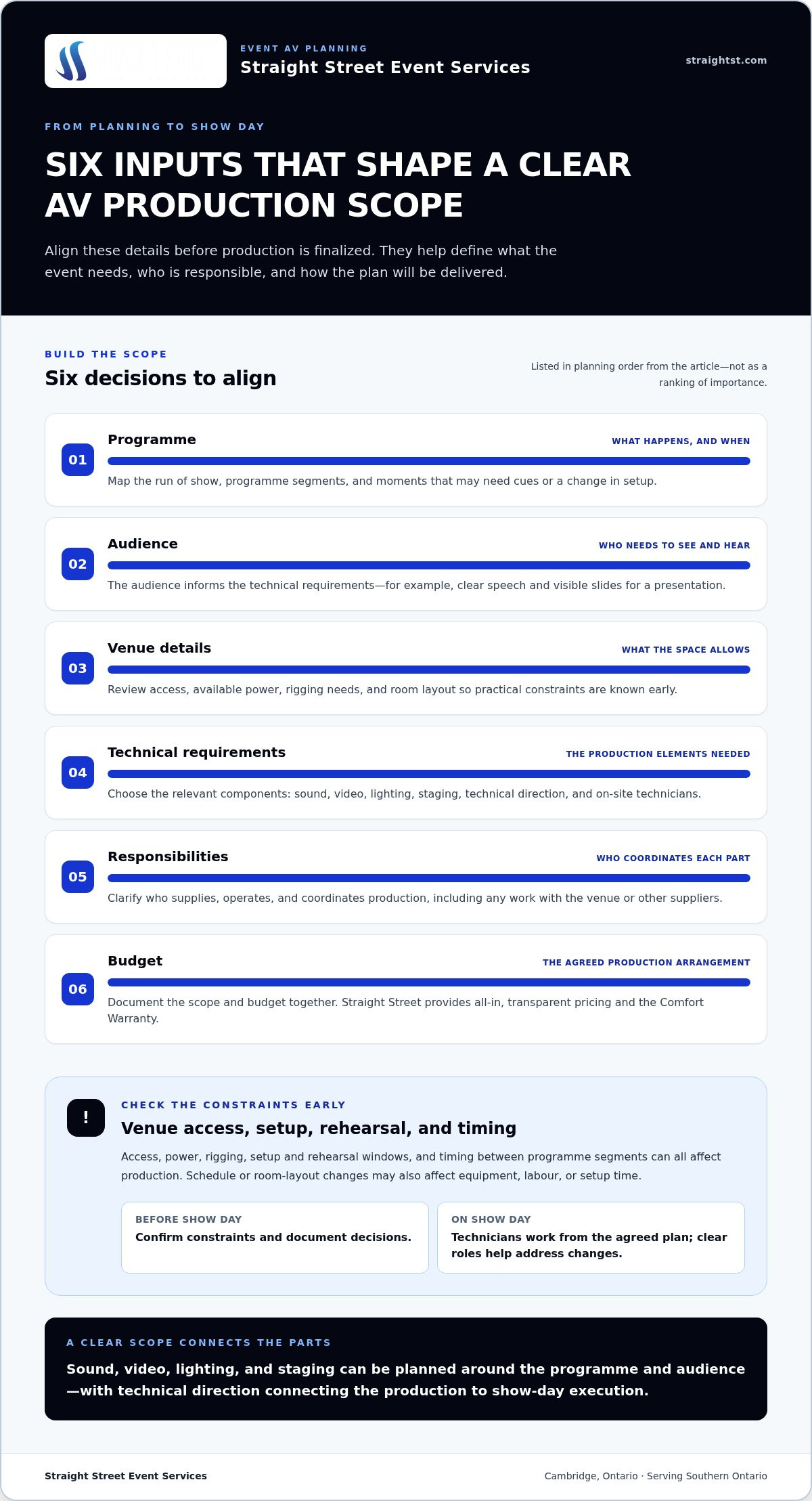
Good show-day execution starts with clear decisions made early enough to act on them. The production team discusses the event’s goals and programme, then reviews the venue, schedule, audience, and technical requirements. That information shapes the scope, responsibilities, and delivery plan.
Early conversations can surface practical constraints while there’s still time to plan around them. Venue access, available power, rigging needs, setup and rehearsal windows, and timing between programme segments can all affect production. Clear communication also identifies where the AV team needs to coordinate with the venue or other suppliers.
What should be settled before event day?
Before production is finalized, align on the programme, audience, venue details, technical requirements, responsibilities, and budget. A schedule or room-layout change may affect equipment, labour, or setup time, so documenting decisions helps keep the scope clear. Straight Street provides all-in, transparent pricing and the Comfort Warranty, giving clients a clear understanding of the production arrangement.
This preparation is part of planning and production management. On show day, technicians work from the agreed plan and respond to actual event conditions. If a schedule shifts or a cue needs adjustment, clear roles help the team respond while keeping the programme moving.
For coordinated planning and on-site execution, Straight Street Event Services supports events across Cambridge and Southern Ontario.
Choosing Full-Service Event AV in Cambridge and Southern Ontario
Integrated production support is useful when an event has several technical elements that need to work together, or when timing and coordination leave little room for last-minute fixes. A conference with presentations, a gala with changing programme segments, or a launch with video cues may benefit from one team coordinating the relevant production. For a simpler setup, you can request a single component instead of a complete solution.
When does one production partner make sense?
Consider how many people and suppliers need to coordinate around the technical plan. Festivals and live performances may involve multiple programme changes; conferences and galas can require different setups across sessions or segments. A production partner can help connect the agreed scope to the event schedule, while still tailoring support to what the event actually needs.
Straight Street Event Services is based in Cambridge, Ontario, and serves Waterloo Region, the GTA, and Southern Ontario, including Guelph, Hamilton, Toronto, and the Windsor corridor. See the full AV production service areas to understand the regional reach. Straight Street has operated since 1997, and founder Keith Kissner brings 40+ years of AV experience.
The practical test is whether one production plan will make responsibilities, timing, and technical coordination clearer for your event. Straight Street can support that work with a single production component or a broader solution; explore Straight Street’s event production services as you define the scope.
Set the Scope for Your Next Event
The right production plan starts with a clear view of what your event needs to accomplish and where technical support will make the biggest difference. Before settling on equipment, identify the key moments in the programme, the people who need to see and hear them, and the parts of production you want handled by one team. That gives you a practical starting point for shaping full service event AV to fit the event, not the other way around.
Straight Street Event Services has operated since 1997, and founder Keith Kissner brings 40+ years of AV industry experience. All-in, transparent pricing and the Comfort Warranty add clarity to the production arrangement. If you’re planning an event in Cambridge or Southern Ontario, take the next step and discuss your event’s AV requirements with Straight Street. A clear conversation can help set the right scope from the start.
Frequently Asked Questions
Can I hire a full-service event AV company for only sound or lighting?
Yes. Straight Street can provide sound or lighting on its own, as well as a complete production solution. For a single component, define who supplies, operates, and coordinates it, and how it connects with venue systems, the programme, and any other AV. That clarity lets a focused full service event AV scope fit the wider event plan.
What happens if event requirements change on the day?
Straight Street’s on-site technicians adapt to changing event needs, with contingency planning helping the team prepare for adjustments. Share changes promptly with the production lead so the technical team can assess their effect on cues, timing, and other components. The Comfort Warranty provides a direct line to on-site staff for issues within Straight Street’s control; it doesn’t promise that every change can be accommodated.
Does Straight Street provide event AV outside Cambridge?
Yes. From Cambridge, Straight Street serves Kitchener, Waterloo, Toronto, Sarnia, Windsor, Mississauga, Hamilton, London, Stratford, Guelph, St. Catharines, Niagara Falls, and other communities across Southern Ontario. Review the regional service areas for coverage details when considering venue location and production coordination.