
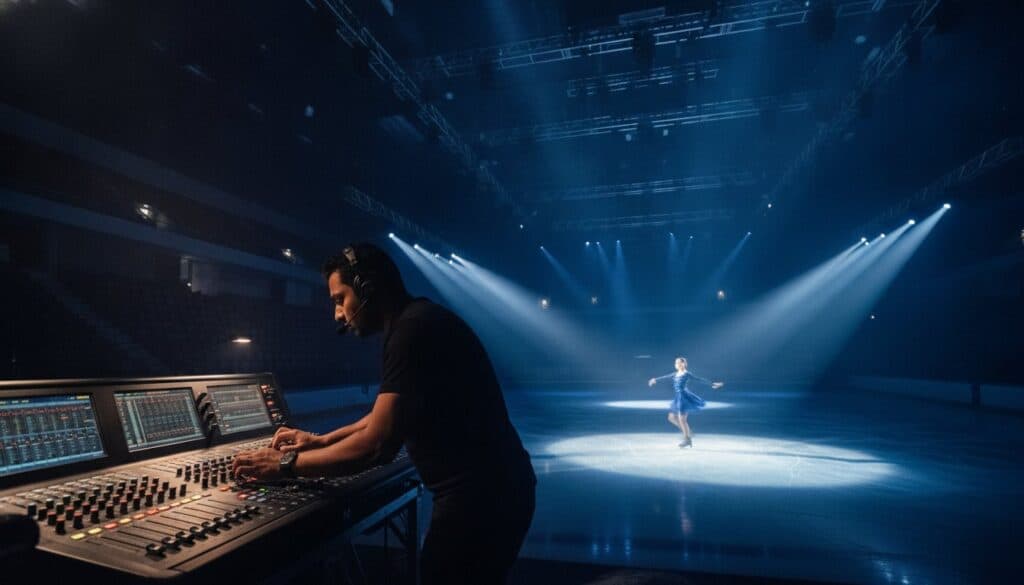
An ice arena is one of the most difficult acoustic environments for any live event. The combination of hard, reflective surfaces—ice, glass, and concrete—creates significant echo and reverb, which can turn a carefully chosen music programme into a muddled wall of sound. Delivering clear, impactful audio for an ice show requires a technical approach designed specifically to overcome these challenges.
Success depends on controlling how sound moves through the space, ensuring every person in the audience and every skater on the ice hears exactly what they need to. It’s a process that balances physics, technology, and hands-on expertise.
Taming Arena Acoustics for Ice Show Audio
The primary audio challenge in an arena is managing reverberation. Sound waves bounce off the ice, the boards, and the high ceilings, arriving at the listener’s ear at different times. This delay, or reverb, makes music and speech difficult to understand. Standard audio setups often make the problem worse by blasting sound in all directions.
Effective ice show AV production requires a strategy to direct sound precisely where it’s needed—at the audience—and away from reflective surfaces. This involves careful equipment selection and placement.
- Strategic Speaker Placement: The goal is to minimize the “slap-back” echo from the far ends of the arena. Using line-array speakers, which offer precise directional control, allows an audio technician to aim sound at the seating sections, reducing reflections off the ice and distant walls.
- Music vs. Public Address: An arena’s built-in sound system is typically designed for public address announcements, not for the dynamic range of music. These systems often lack the low-end and high-end frequency response needed for a rich performance, making a dedicated, professional system essential.
- Digital Signal Processing (DSP): Modern audio consoles use DSP to digitally time-align speakers. This ensures that sound from multiple speakers arrives at the audience simultaneously, creating a single, clear audio image rather than a confusing echo.
Audio for Skaters and the Audience
A successful show requires two distinct audio mixes: one for the audience and one for the performers. Skaters rely on clear audio cues to synchronize their movements, but placing monitors directly on or near the ice can create feedback and disrupt the main mix that the audience hears.
The solution is a carefully managed foldback system. Low-profile speakers, or “monitors,” are placed discreetly along the boards, providing skaters with the clarity they need without interfering with the main house sound. An experienced technician can balance these two systems to ensure both performers and spectators have an ideal listening experience.
Advanced Miking for On-Ice Clarity
Beyond the music, the subtle sounds of the performance itself add a powerful dimension to an ice show. The crisp sound of a skate blade cutting across the ice or the percussive hit of a toe pick can connect the audience more deeply to the athleticism on display. Capturing these sounds in a massive arena requires specialized microphone techniques.
This is not just about making things louder; it’s about adding texture and detail to the audio experience. Through careful planning and execution, these details can be woven into the main audio mix.
- Specialized Microphones: Boundary microphones placed along the boards or even contact microphones installed under a section of the ice can capture the physical sounds of skating. This technique requires significant technical skill to isolate the desired sounds from crowd noise and reverb.
- Wireless Reliability: Ice shows depend on wireless microphones for announcers and performers. A 200-foot sheet of ice in a steel-and-concrete building is a high-interference zone where standard wireless gear often fails. Professional live event production relies on robust RF coordination—a process where a technician scans for open frequencies and manages all wireless equipment to prevent dropouts.
Executing Professional Sound for Southern Ontario Ice Productions
Whether your event is at a community rink in Kitchener or a major arena in the GTA, the principles of good audio production remain the same, but the logistics change. Local knowledge is critical for navigating venue rules, power availability, and load-in procedures efficiently. A production partner based in Southern Ontario understands the specific challenges and opportunities of venues across the region.
Our process is built on clear communication and planning to eliminate guesswork. We believe that a successful event is one with no technical surprises, which is why our work is backed by a Comfort Warranty and features all-in, transparent pricing. You know exactly what to expect from the start.
The Straight Street Process: From Load-in to Final Bow
A successful production begins long before the doors open. We start with a site audit to map the venue’s acoustics and identify logistical needs, from power distribution to cable management paths that are safe for skaters and staff. This planning ensures that on show day, our team can execute efficiently, focusing on delivering a flawless performance.
Our technical direction prioritizes the goals of the show, ensuring the audio supports the performers and engages the audience. To see examples of how this detailed approach works for various events, you can review some of our past projects on our Our Work page.
Practical Budgeting for Professional Sound
Professional audio production doesn’t have to mean renting every piece of gear available. A well-designed system uses the right equipment for the specific venue and show, avoiding unnecessary costs. By focusing on the equipment that will have the greatest impact on sound quality and control, we can deliver excellent results that respect your budget.
Transparent planning helps align the technical capabilities with your financial realities. For more on how this works, see our guide on what transparent AV budgeting should look like.
Ultimately, great audio for an ice show is about control. It’s the result of a deliberate technical strategy that manages the difficult acoustics of an arena, ensuring the music and performance are heard with clarity and impact. This requires specific equipment, detailed planning, and the on-site expertise to adapt to the live environment.
Frequently Asked Questions
How do you stop the echo in a large ice arena?
Echo, or reverb, is managed primarily through speaker selection and placement. We use line-array speakers to direct sound at the audience and away from reflective surfaces like the ice and far walls. Digital Signal Processing (DSP) is also used to time-align the speakers, ensuring sound arrives as a single, clear source.
Can we use the arena’s built-in PA system for our ice show music?
It is generally not recommended. Most in-house PA systems are designed for the limited frequency range of spoken announcements, not for the dynamic, full-range sound of music. A dedicated, professional audio system provides the control and quality needed for a performance.
How do you prevent wireless microphone interference during a live skating performance?
We use professional-grade wireless systems and conduct on-site RF (radio frequency) coordination. A technician scans the airwaves to find clean, open frequencies for all wireless microphones and communication devices, and actively monitors them throughout the show to prevent dropouts.
What is the best speaker placement for an audience seated around the ice?
For most arena shows, the ideal setup involves flying speakers from the ceiling rigging points. This allows the sound to be aimed down toward the seating areas in a controlled pattern, providing even coverage for the entire audience while minimizing sound spill onto the ice and other reflective surfaces.