
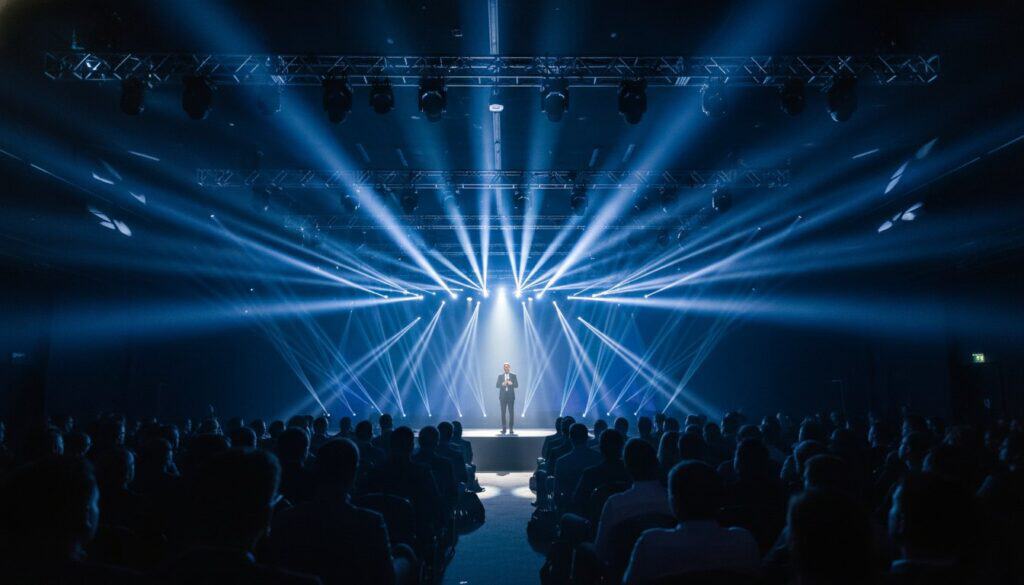
Relying on a venue’s standard house lights for a corporate event often leads to a flat, unengaging atmosphere and poor-quality video for anyone watching remotely. Professional lighting solutions are not just about making a room brighter; they are about strategically controlling the visual environment to direct audience attention and ensure your message is presented clearly and professionally.
Effective lighting design transforms a generic space into a focused environment. It is a foundational element of successful audiovisual production that supports your presenters, reinforces your branding, and creates a better experience for attendees both in the room and online.
Beyond Basic Illumination: The Function of Professional Lighting
The difference between basic illumination and a professional lighting setup is control. While house lights serve the simple function of visibility, professional lighting solutions are a tool used to guide focus, establish a specific mood, and create a clean, polished look for the stage and speakers.
This transition from general visibility to a controlled atmosphere is critical in high-stakes corporate environments. Instead of a uniformly lit room where the audience’s attention can wander, a well-designed lighting plot directs everyone’s focus to the presenter, a product reveal, or a branded stage set. It subtly tells people what is important and when.
The Practical Effects of Light on an Audience
The technical aspects of lighting have a direct impact on audience engagement. Colour temperature and intensity can influence focus and help maintain energy levels during long sessions. For example, a crisp, clean light on a keynote speaker creates a professional, authoritative look, while warmer tones can make a space feel more welcoming for a networking reception.
Shadows and contrast are also important, particularly for video. A flat, shadowless stage looks uninteresting on camera. An experienced lighting director uses a combination of key lights, fill lights, and backlights to create depth, making speakers stand out from the background and ensuring a high-quality look for any hybrid or virtual event stream.
- Visual Hierarchy: At its core, professional lighting establishes a visual hierarchy, using light to tell the audience what matters most in the room at any given moment.
- Brand Reinforcement: Custom colours and projected logos (gobos) can transform a neutral venue into a branded environment, consistently reinforcing your organization’s identity.
- Camera-Ready Conditions: Lighting designed for the human eye is not always suitable for cameras. Professional setups are calibrated to be “broadcast safe,” eliminating flicker and colour issues that can ruin a video feed.
Planning Lighting for Live and Hybrid Events
A successful lighting plan is based on the specific needs of the event, including venue size, audience location, and content goals. Whether it’s a single-podium press conference or a multi-stage corporate conference, the technical infrastructure must be planned to support the event’s objectives without causing on-site complications.
A modern event lighting rig typically includes a mix of fixtures, such as moving lights for dynamic effects, washes for broad colour coverage, and spotlights to isolate speakers. However, the equipment is only one part of the equation. Technical direction is essential to ensure that lighting works in sync with audio, video, and staging cues, creating a cohesive and professional presentation.
Balancing the In-Person and Virtual Experience
Lighting for a hybrid event presents a unique challenge: the stage must look great to the people in the room while also being perfectly lit for cameras. This requires specific techniques to manage contrast and brightness so that both audiences have a clear view. Without proper planning, a stage that looks fine in person can appear washed out or poorly lit on a webcast.
Three-point lighting is a standard practice for ensuring speakers look their best on screen, helping them pop against digital backdrops or LED walls. As a key component of virtual and hybrid events, this level of detail prevents the flat, unengaging video feeds that often result from basic lighting setups.
Reducing Risk Through Technical Planning
One of the biggest risks in live event production is encountering unexpected technical issues on-site. Detailed CAD drawings and lighting plots are crucial for preventing these “surprises.” They allow our team to map out every fixture, cable run, and power requirement in advance, ensuring everything fits within the venue’s limitations and the event’s budget.
Pre-visualization software also allows clients to see a rendering of the lighting design before the first piece of equipment is loaded in. This process provides clarity and confidence, ensuring the final result aligns with your expectations and avoiding costly last-minute changes.
Execution and Reliability: The Southern Ontario Approach
In live events, flawless execution is everything. Having a team with deep local expertise in venues across Southern Ontario, from Toronto and Hamilton to Kitchener and Windsor, is a significant advantage. This familiarity with local venues means we already understand their specific logistical challenges, power requirements, and load-in procedures, which saves time and prevents problems.
At Straight Street, we operate with a “no surprises” philosophy built on clear communication and meticulous planning. Our all-in, transparent pricing ensures you know the full cost upfront, and our Comfort Warranty guarantees that our technical execution will be flawless. We see our role as a technical partner dedicated to making your event run smoothly.
Execution Over Equipment
The best equipment in the world is ineffective without an experienced team that understands the rhythm and flow of a live show. Our technicians and directors do more than just set up lights; they manage the complex interplay between light, sound, and video to support the event’s key moments.
This commitment to reliable live event production has been the foundation of our work for over 30 years. We build trust by being transparent, conducting thorough technical audits, and managing expectations from the first call to the final load-out.
Local Knowledge for Dependable Events
A successful event is one where the technology is so well-integrated that it becomes invisible, allowing the message and the presenters to be the sole focus. Our experience across Southern Ontario’s key event hubs, including Cambridge, Waterloo, and the GTA, gives our clients the confidence that every technical detail is handled.
Ultimately, professional lighting solutions are a critical part of your event’s technical foundation. Working with an experienced, local partner ensures that your audience has a clear, engaging, and professional visual experience from start to finish.
To discuss the lighting solutions for your next corporate event in Southern Ontario, contact Straight Street for a technical consultation.
Frequently Asked Questions
What is the difference between general event lighting and professional lighting solutions?
General event lighting, like a venue’s house lights, provides basic visibility. Professional lighting solutions involve a strategic design using specialized equipment to control focus, create atmosphere, reinforce branding, and ensure a high-quality look for both in-person and camera-based audiences.
How does lighting affect the quality of a hybrid or virtual event stream?
Lighting is critical for video quality. Without lighting designed for cameras, a video stream can look flat, washed out, or unprofessional. Proper techniques like three-point lighting ensure speakers are clear and distinct from their backgrounds, creating a polished broadcast look.
Can professional lighting help stay within a tight event budget?
Yes. While it is an investment, professional lighting can reduce the need for extensive physical set pieces by using colour and texture to define a space. More importantly, detailed pre-planning with lighting plots prevents costly on-site labour overruns and last-minute equipment additions.
What should I look for when hiring a lighting production company in Southern Ontario?
Look for a company with a proven track record in your specific region (e.g., Toronto, Kitchener-Waterloo, Windsor). They should demonstrate deep technical knowledge, offer transparent planning with tools like CAD drawings, and have extensive experience lighting for both live and hybrid events. A focus on execution and reliability is more important than just a list of equipment.