
The Strategy Behind Professional AV Equipment Rentals
Renting audiovisual equipment should be a straightforward process, but a simple list of gear rarely guarantees a successful event. Professional AV equipment rentals involve more than just hardware; they combine reliable equipment with the technical knowledge required for flawless execution. This approach is built on a “no surprises” philosophy, where transparency and expert planning prevent issues before they happen.
Unlike consumer electronics, professional-grade equipment is designed for stability and redundancy. It can handle the demands of a live environment, from maintaining a stable video signal over long distances to delivering clear audio in a challenging acoustic space. Local expertise is also critical. Understanding the specific technical nuances of venues across Southern Ontario, from large Toronto convention centres to tech hubs in Kitchener-Waterloo, is key to building a technical plan that works.
Moving Beyond the Equipment List
A quote for “two speakers and a microphone” is insufficient without understanding the room’s size, shape, and acoustic properties. The goal is to translate your creative vision into a detailed gear manifest that accounts for the environment. This is the role of technical direction.
A proper technical plan identifies potential points of friction ahead of time. Will the venue’s power supply support the lighting rig? Is there wireless frequency interference that could affect the microphones? Answering these questions beforehand is the difference between a smooth event and a stressful one.
The Real Cost of Technical Failure
An audio dropout during a CEO’s address or a lagging video feed can completely undermine your message and damage your brand’s credibility. While “dry hires”—renting gear without technical support—may seem like a way to save on the budget, they often carry a higher long-term risk.
Without an experienced technician on-site, a simple issue can quickly become a major problem. This is why professional audiovisual production focuses on technical redundancy: the practice of having backup signal paths for mission-critical event elements. It’s a safety net that ensures the show goes on, no matter what.
Choosing the Right AV Solutions for Your Event
Selecting the right equipment starts with your event’s goals, not a catalogue of gear. For audio, the priority should always be clarity and even coverage throughout the room, not just raw volume. For video, the screen’s brightness (measured in lumens) and resolution must be matched to the venue’s ambient light to ensure your content is seen clearly.
Often, the biggest objection event planners face is a venue insisting on the use of their in-house system. While convenient, a built-in system may not be suited for your specific needs, lacking the right microphones for a panel discussion or a bright enough projector for a sunlit room. In these cases, bringing in a dedicated audiovisual production partner ensures your technical requirements are fully met.
Audio and Video: The Foundation of Connection
The right microphone depends entirely on the application. A handheld wireless mic offers flexibility for an active presenter, while discreet lapel mics are better for a seated panel. We also analyze a room’s radio frequency (RF) environment to select equipment that avoids interference from other wireless signals.
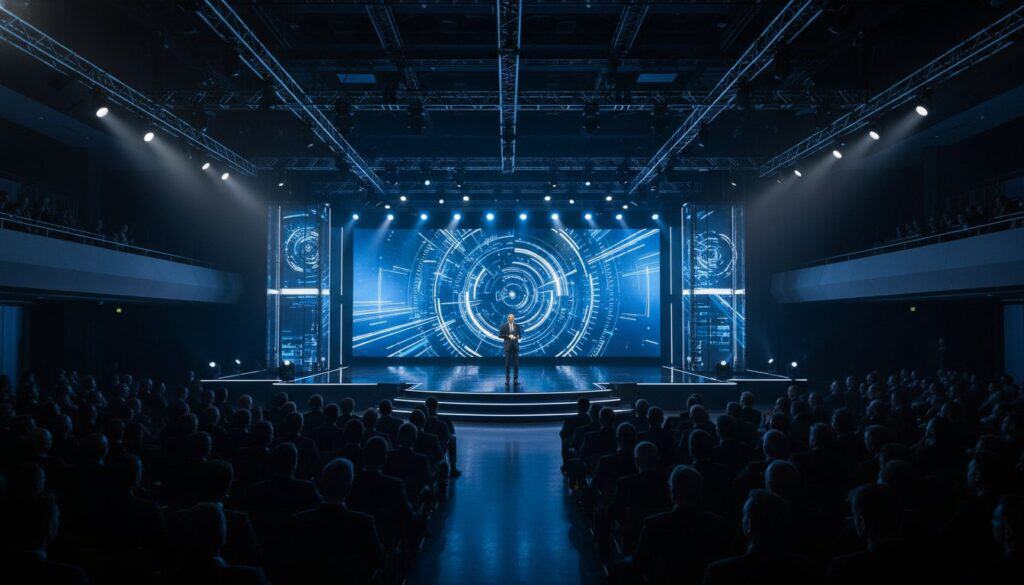
In the bright ballrooms common in Southern Ontario, traditional projectors can appear washed out. High-resolution LED video walls provide the necessary brightness and contrast to make video content pop, even in a fully lit space. This ensures that both in-person and remote audiences have a clear view of presentations and videos.
Lighting and Staging: Practical Considerations
Effective lighting and staging are about more than just aesthetics; they are crucial for a functional event. Good lighting ensures presenters are clearly visible to both the live audience and video cameras. Staging must be planned with sightlines in mind, so every attendee has a clear view of the action.
Safety is also a primary concern, from properly secured trussing to safely taped-down cables. For hybrid events, backdrops and scenic elements should be chosen to look good on camera, avoiding busy patterns or reflective surfaces that can distract the online audience. The goal is a clean, professional look that supports your message.
Execution Without Surprises: The Straight Street Approach
Our process is designed for clarity and reliability, from the initial technical audit to the final strike of the equipment. We believe in all-in, transparent pricing, so you see every cost upfront without any hidden fees. This commitment is backed by our Comfort Warranty, which guarantees we have the right plan and people in place to execute your event properly.
An on-site audiovisual technician is essential for managing adjustments in real time. They monitor the complex network of equipment and ensure the signal flow—the path an audio or video signal takes from the source to the audience—is uninterrupted. This hands-on management is what separates a professional production from a simple rental.
Technical Direction and On-site Support
The technical director acts as the conductor of your event, coordinating all the audio, video, and lighting cues to ensure they happen at the right moment. The idea of “set it and forget it” simply doesn’t apply to live events, where conditions can change unexpectedly. A presenter might move away from a microphone, or a new video file might need to be loaded at the last minute.
Our on-site technicians are there to handle these variables, making adjustments on the fly to keep the event running smoothly. This active management is a core part of our commitment to delivering a stress-free experience for our clients across Southern Ontario. For more complex shows, especially those with remote elements, this support is even more critical. You can learn more about our approach to virtual and hybrid events here.
Planning for Hybrid and Live Environments
Hybrid events require a specific set of tools to bridge the gap between the in-person and virtual experiences. This includes webcasting hardware, low-latency video encoders, and separate audio mixes to ensure the online audience hears everything clearly. The goal is to make the virtual broadcast feel just as engaging as being in the room.
Careful planning ensures that the production values are consistent for both audiences. This might mean using specific camera angles and lighting techniques that translate well to a screen, creating a cohesive experience for everyone, regardless of where they are watching from.
Frequently Asked Questions
What is typically included in a professional AV equipment rental package?
A professional package includes not only the hardware (microphones, speakers, screens, etc.) but also all necessary cabling, power distribution, and setup/teardown labour. More importantly, it includes the technical planning and on-site support needed to ensure everything works together correctly.
Do I need an on-site technician for my corporate event in Toronto?
For any event with multiple technical elements or mission-critical presentations, an on-site technician is highly recommended. They provide real-time problem-solving and quality control, managing everything from audio levels to presentation cues, which is invaluable for a high-stakes corporate event.
How far in advance should I book AV rentals for a major conference in Southern Ontario?
For major conferences, it’s best to book your AV partner 3-6 months in advance. This allows ample time for thorough venue assessments, technical planning, and securing the specific equipment and personnel required for a large-scale event.
What is the difference between a “dry hire” and a full-service AV production?
A “dry hire” is the rental of equipment only, with no technical staff provided. A full-service AV production, which is what we specialize in, includes technical direction, on-site technicians, and a complete strategy to ensure the equipment is used effectively to achieve your event’s goals.
What happens if there is a technical failure during my live event?
With a professional team on-site, most potential failures are prevented through redundant systems. If an issue does occur, such as a microphone battery dying, the technician can resolve it immediately, often before the audience even notices. This is a key benefit of having expert support.