
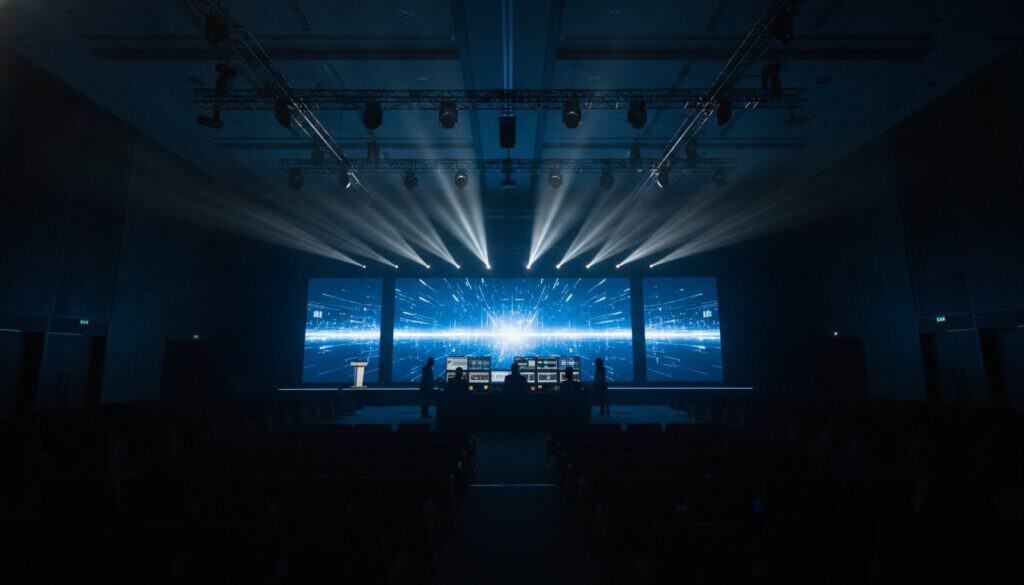
The Landscape of Live and Hybrid Event Production in Ontario
Coordinating a hybrid event introduces a layer of technical complexity that many planners aren’t prepared for. What might be a minor glitch for an in-person audience can become a show-stopping failure for those attending remotely, undermining the entire event’s purpose and damaging your organization’s credibility. In today’s event landscape, hybrid is no longer an add-on; it’s a core component that demands professional execution.
Successfully producing an event for two distinct audiences—one in the room and one online—requires a unified approach. This is especially true across the busy Windsor-to-Toronto corridor, where logistics are complex. Effective technical production is the foundation that ensures both groups share a consistent, high-quality experience.
Bridging the Gap Between Physical and Virtual Audiences
To keep a remote audience engaged, they need more than a single, static webcam view of the stage. Professional video production is essential to make them feel like active participants rather than passive observers. This involves using multiple camera angles, clear graphics, and high-quality audio to capture the energy of the live event.
The goal is to move beyond simple webcasting and create a professional broadcast. It’s about ensuring the person watching from their office in another city receives the same key messages and feels the same impact as the person sitting in the front row. This requires a technical partner who understands the distinct needs of a virtual audience.
Why Technical Reliability is Non-Negotiable
Technical failures do more than just interrupt a presentation; they erode trust. A dropped audio feed, a frozen video stream, or a presentation that won’t display properly distracts from your message and makes the entire event feel unprofessional. For high-stakes corporate events, galas, or conferences, the risk of technical issues is too great to leave to chance.
A seamless audiovisual experience allows your content to be the focus. When the technology works correctly, it becomes invisible, allowing the speakers and their message to connect with the audience without interference. This reliability is not an accident; it’s the result of meticulous planning and professional oversight.
Evaluating Live and Hybrid AV Providers: A Decision Framework
Choosing from the many live and hybrid AV providers in Ontario can be challenging. A flashy gear list doesn’t guarantee a successful event. A better approach is to evaluate potential partners based on their process, experience, and commitment to a smooth execution. A clear decision framework helps you identify a true partner, not just an equipment rental shop.
- Assess their commitment to pre-event planning. Does their process include detailed discovery calls, site visits, and risk mitigation strategies? A proactive partner identifies potential problems weeks before the event, not on the day of.
- Look for dedicated technical direction. You need a single point of contact who is responsible for the entire technical execution, not just a crew of operators. This person orchestrates all the audio, video, and lighting cues to ensure a cohesive production.
- Evaluate their experience in Southern Ontario. A provider with deep experience in Toronto, Kitchener, Hamilton, and other local venues will understand the unique logistics, from load-in challenges to working with local labour.
- Prioritize transparency in communication. Your AV partner should provide clear, straightforward proposals and be available to answer questions. This is where our all-in, transparent pricing ensures there are no financial surprises after the event is over.
The Role of Technical Direction in Complex Events
A Technical Director (TD) is the conductor of your event’s technical orchestra. While technicians focus on operating their specific equipment—like audio consoles or cameras—the TD oversees the entire production, ensuring all elements work together in sync. They are the crucial link between your event plan and the technical crew.
Having a dedicated TD significantly reduces the burden on the event planner. Instead of managing multiple AV contacts, you have one expert who is accountable for the entire technical result. This is a key differentiator between a basic AV supplier and a professional production partner. You can learn more about our approach to live event production and the central role of technical direction.
Beyond the Gear List: What Really Matters
An extensive inventory of speakers, lights, and screens is only a small part of the solution. The real value of a technical partner lies in their ability to use that equipment effectively and troubleshoot problems in real-time. An experienced team can solve unexpected issues on-site before they impact the event.
When evaluating providers, ask about their team’s experience and their process for handling unexpected challenges. A true partner takes the time to understand the “why” behind your event, which allows them to make smarter technical decisions that support your ultimate goals.
Ensuring Execution: The ‘No Surprises’ Approach to Ontario Events
The foundation of a “no surprises” event is built on clear communication and thorough preparation in the weeks leading up to it. This proactive approach is the most effective way to prevent day-of failures and ensure every detail is accounted for. It’s a commitment to process that guarantees a higher standard of execution.
For events in Southwestern Ontario venues, from London to Niagara Falls, site visits are essential. They allow a technical team to confirm everything from power availability to rigging points, eliminating guesswork. This is also where staging and lighting are planned not just for illumination, but as tools to direct audience focus and create a professional environment that aligns with your brand.
Staging and Scenic Design: Creating the Environment
The physical environment of your event sets the tone for your audience. Professional staging and scenic elements, like custom backdrops and stage design, create a polished focal point for both the in-person and virtual attendees. This ensures clean sightlines for everyone in the room and a professional, branded background for the camera shots.
Lighting production works hand-in-hand with staging to create a specific mood and direct attention. Proper lighting ensures speakers are clearly visible, highlights key branding elements, and adds a layer of professionalism to the entire production. For hybrid events, a lighting plan designed for the camera is critical. You can explore our work in hybrid and virtual environments to see how these elements come together.
The Local Advantage: Serving the Southern Ontario Corridor
Working with a local audiovisual partner provides significant practical advantages. As a Cambridge-based team, we have decades of experience serving clients across the Southern Ontario corridor, including Waterloo, Guelph, and the GTA. This regional expertise translates directly into reduced risk and logistical costs for your event.
Our familiarity with the region’s venues means we already know what to expect, and our proximity allows us to be more flexible and responsive. This local presence is backed by our Comfort Warranty, a guarantee that we will deliver exactly what we promised. Ultimately, choosing a partner with deep local roots is a practical decision that contributes to a smoother, more reliable event execution.
Choosing the right live and hybrid AV provider in Ontario comes down to partnership, not just equipment. Prioritizing detailed planning, dedicated technical direction, and local expertise is the most effective way to reduce risk and ensure a successful event for every audience member.