
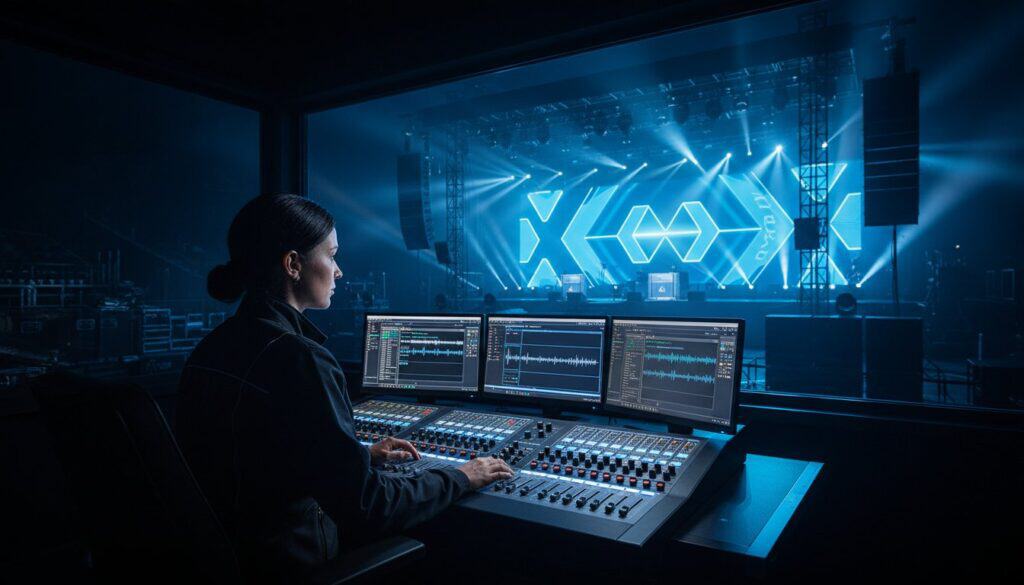
What if the most defining moment of your keynote is met with a piercing screech of feedback or a screen that suddenly fades to black? You’ve spent months orchestrating every detail, yet the technical foundation feels like a fragile variable you can’t quite control. Most organizers share this underlying anxiety, knowing that common event AV mistakes often stem from a simple lack of clarity between the venue and the production team.
It’s possible to move past the fear of dead microphones and unexpected line items on your final invoice. This guide identifies the specific technical risks facing corporate events in 2026 and provides a roadmap for preventing failure through intentional planning and honest communication. We’ll explore how our Comfort Warranty and all-in, transparent pricing provide the stability you need to focus on your guests while we handle the technical direction from our centre in Cambridge, ensuring your vision remains the focal point of the day.
Key Takeaways
- Coordinate with your venue early to verify that electrical capacity and rigging points in Southern Ontario facilities can support modern high-output audio and LED walls.
- Avoid common event AV mistakes by matching microphone selection to your room’s acoustics and ensuring presentation decks align with the screen’s aspect ratio.
- Protect your budget from hidden fees and unexpected surcharges by insisting on all-in, transparent pricing for all equipment and labour.
- Transition from simple equipment rentals to a partnership that includes on-site technicians who provide technical direction and immediate support.
- Secure your production with our Comfort Warranty, ensuring a reliable technical foundation for every keynote and presentation.
Technical Planning and Venue Coordination Errors
The foundation of any gathering is the space itself. Many event AV mistakes occur long before the first guest arrives, often hidden within the floor plans of historic Southern Ontario venues. A grand ballroom in Kitchener or a heritage space in Hamilton might offer character, but they rarely provide the modern electrical infrastructure required for high-density LED walls. Assuming the venue’s power is sufficient is a gamble that often ends in a dark room.
Disregarding Electrical Loads and Rigging Limitations
You can’t run a cinematic production on a standard wall outlet. High-output audio systems and vibrant displays demand dedicated power circuits. Without a technical site visit, you risk blown breakers during the most critical moment of your presentation. We verify weight-bearing capacities for every rigging point to ensure safety and stability. This level of technical direction is a core part of our live event production services. Understanding the physical constraints of audiovisual (AV) setups prevents costly last-minute adjustments. It’s about respecting the architecture while pushing the limits of the craft.
Neglecting Technical Rehearsals and Cue Mapping
A successful event requires more than just functional gear; it needs a shared rhythm. Technical rehearsals allow our on-site technicians to map every transition and catch software conflicts before the room fills. If multiple vendors manage different elements, cues often get lost in the gaps. We eliminate this friction through all-in, transparent pricing that includes the labour necessary for a proper run-through. Our Comfort Warranty is built on this preparation, ensuring that every speaker is heard and every visual lands with impact.
From our home base in Cambridge, we coordinate these logistics directly with the venue. Ignoring the load-in and load-out schedule is a trap that leads to rushed setups and increased labour costs. By managing these timelines with precision, we reduce the risk of common event AV mistakes and protect the integrity of your budget.
Practical Failures in Audio, Video, and Lighting Execution
Execution is the moment where technical theory meets the human experience. Even the most carefully planned keynote can falter if the audio lacks clarity or the visuals feel disjointed. These practical event AV mistakes often occur when the technical team prioritizes the equipment over the specific needs of the presenter. It’s about capturing the quiet confidence of a speaker and projecting it with authority to every corner of the room.
Poor Audio Management and Microphone Feedback
Sonic clarity is the bridge between a speaker’s intent and the audience’s understanding. A common error is failing to calculate gain-before-feedback, which determines how loud a microphone can get before it begins to squeal. Choosing the right tool is essential. A lapel microphone offers freedom for a static presenter, but a headset provides consistent audio quality for someone who moves their head frequently. Handheld microphones remain the standard for Q&A sessions, yet they require proper technique to avoid muffled sound. Our hybrid event production services focus on capturing this audio for both the room and the remote audience without compromise.
Lighting for Video and Hybrid Audiences
Light has the power to transform a sterile stage into a cinematic environment, yet it’s often the most overlooked element. What looks natural to the eye in a ballroom often appears flat or shadowed on a camera sensor. Balancing colour temperature is vital; mixing warm stage lights with cool LED video walls creates a muddy image for virtual attendees. We design lighting plots that define the speaker against the background, ensuring they don’t look washed out during a high-stakes livestream. This level of technical oversight is a standard part of our work in the Kitchener-Waterloo and GTA corridors.
Video execution also requires precision in aspect ratios and resolution. Presentation decks created in older formats often look amateurish when stretched across a modern widescreen display. We eliminate these visual gaps by verifying all content during setup. To ensure your stream never drops, we implement signal redundancy, providing a secondary path for data if the primary connection fails. It’s a level of security designed to prevent common event AV mistakes, backed by our Comfort Warranty and all-in, transparent pricing.
Budgeting Oversights and the Importance of Accountable Partners
Budgeting is the quiet foundation of a successful event. It’s where vision meets reality. One of the most common event AV mistakes is the “drop-and-dash” rental. It’s a trap. You get the gear, but you lose the support. Gear doesn’t solve problems. People do. Without an on-site technician, a simple sync issue between a laptop and a projector can derail an entire morning session.
The Hidden Costs of Fragmented AV Services
Managing separate vendors for audio, video, and lighting often leads to a communication breakdown. When the video team requires a specific feed that the audio crew didn’t prepare for, the resulting friction creates delays. These gaps often manifest as hidden fees for last-minute adapters, power distribution, or late-night labour surcharges. These “extras” can inflate a final invoice by 30% after the doors have closed. We prevent this by serving as a single accountable partner from our Cambridge office, overseeing the entire technical direction from load-in to the final load-out.
Guaranteeing Success with the Comfort Warranty
True partnership requires financial honesty. We operate with all-in, transparent pricing so that the quoted price remains the final price, regardless of the technical hurdles we solve on-site. This commitment is anchored by our Comfort Warranty. It’s a written promise of price integrity and issue resolution. It’s our guarantee that we’ll handle the technical complexities of your Southern Ontario event so you can focus on your guests. By eliminating the fear of unexpected costs, we build a foundation of trust that lasts long after the final presentation ends.
Securing the Technical Integrity of Your Next Event
Technical failure isn’t inevitable. It’s often the result of small oversights in planning or communication that compound when the house lights go down. By prioritizing early venue coordination and insisting on a single accountable partner for your technical direction, you eliminate the variables that lead to common event AV mistakes. True success is found in the quiet moments of a flawless keynote where the technology serves the message rather than distracting from it.
We’ve spent 30 years refining our craft across Southern Ontario, from our home in Cambridge to the heart of the GTA. As a Consumer Choice Award Winner for 2026, we provide a written Comfort Warranty and all-in, transparent pricing to ensure your budget remains predictable. You deserve a partner who values the human connection behind every presentation as much as the hardware that supports it. Request an all-in, transparent quote for your Southern Ontario event and let’s build something that resonates with your audience. Your vision is safe in our hands.
Frequently Asked Questions
What is the most common AV mistake made during corporate events?
The most frequent error is waiting until the final weeks of planning to engage a production partner. This delay often leads to a disconnect between the venue’s physical limits and the technical requirements of the show. Many organizers assume that a grand ballroom in the GTA or Kitchener automatically possesses the power for high-density LED walls. Engaging us early allows for a proper site visit to verify infrastructure before contracts are signed.
How do I prevent microphone feedback during a presentation?
Preventing feedback requires a precise calculation of the room’s acoustics and the speaker’s movement. Feedback happens when sound from the speakers re-enters the microphone, creating a loop of noise. Our technicians manage this by tuning the system to the specific frequencies of the venue. Choosing the right microphone, like a headset for a mobile speaker, ensures consistent audio levels while reducing the risk of common event AV mistakes during a live keynote.
Why do I need a technical rehearsal if the equipment is high quality?
High-quality equipment is a tool, but the technical rehearsal is the craft that makes it sing. Even the best hardware can’t account for a presentation deck with the wrong aspect ratio or a laptop that refuses to handshake with a video switcher. These sessions allow the speaker and the technician to find a shared rhythm. It’s the only way to catch software conflicts and wireless interference before the room fills with guests.
What should be included in an all-in AV production quote?
A truly transparent quote must include the equipment, transport, setup labour, and dedicated on-site technicians for the duration of the show. It should also account for the small but vital elements like power distribution, adapters, and signal converters. We provide all-in, transparent pricing backed by our Comfort Warranty. This ensures that the price you see at the start is the exact amount on your final invoice, with no hidden fees for cables or late-night labour.