
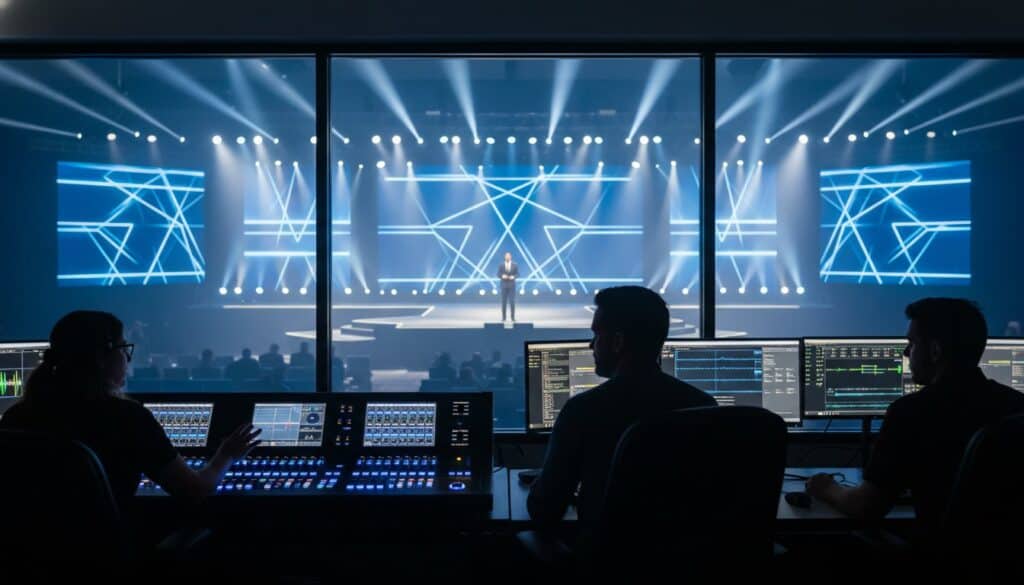
Executing a high-stakes corporate event in Ontario comes with significant pressure. A single technical failure—a dead microphone, a flickering screen, a lagging video feed—can undermine your entire message, making a reliable production partner essential for protecting your brand’s credibility.
The success of your event depends not on the quantity of equipment, but on the quality of the technical foundation supporting it. This is the core of professional commercial event production.
The Scope of Professional Commercial Event Production in Ontario
Many people associate event production with simple AV equipment rentals, but this view misses the most critical component: integrated technical management. Professional commercial event production is the strategic integration of technology to support human communication. It’s a unified system where audio, video, and lighting work together to ensure your message is delivered clearly and effectively.
This approach moves beyond a checklist of gear and focuses on the outcome. Instead of just renting a sound system, you gain a partner who designs that system to provide perfect vocal clarity in a specific venue. Instead of just ordering projectors, you get a team that manages video signals for both the in-person audience and your virtual attendees. This comprehensive oversight is what separates a professional production from a simple rental.
Beyond the Basics: Audio, Video, and Lighting
While all technical elements are important, they serve distinct functions. Professional audio is arguably the most critical component for any corporate event. If your audience cannot clearly hear the presenter, the message is lost, and engagement drops immediately. A professional team focuses on eliminating feedback, managing microphone levels, and ensuring consistent sound coverage for everyone in the room.
Lighting serves to direct focus and create a professional atmosphere that aligns with your brand. Proper lighting ensures speakers are clearly visible, both in the room and on camera, while stage and room lighting can transform a generic space into an environment that feels intentional. Video elements are crucial for engaging attendees with presentations, pre-recorded content, and live camera feeds that give everyone a front-row seat. For hybrid events, video is the primary connection to your virtual audience.
Staging and Scenic Elements as a Professional Framework
Staging and scenic design provide the physical foundation for your event. A well-built stage gives your presenters a defined focal point, while branded backdrops and other scenic elements transform a standard hotel ballroom into a space that reflects your company’s identity. It’s not about extravagance; it’s about creating a clean, professional environment that supports your message.
More importantly, professional staging ensures structural integrity and safety. A production partner manages the technical details of weight loads, secure construction, and clean cable management, removing these risks from your plate. This attention to detail creates a polished look and prevents preventable accidents. Discover more about our approach to building these foundations in live event production.
The "No Surprises" Methodology: Planning for Technical Reliability
The most common fear for any event organizer is an unexpected technical failure. This is why a methodical planning process is the most valuable service a production partner provides. Clear communication and detailed pre-production are the best tools for reducing total event risk and ensuring a smooth execution on the day.
A key figure in this process is the Technical Director (TD). The TD acts as the bridge between your vision and the technical crew, translating your goals into a concrete action plan. They oversee all technical departments to ensure every piece of equipment works together as a cohesive system. This centralized management prevents the miscommunications that often lead to day-of-show problems.
This commitment to clarity extends to our process. We provide all-in, transparent pricing so you have a firm, reliable number from the start, and our Comfort Warranty ensures we stand behind our work. Trust is built when there are no surprises—either on the invoice or on the stage.
Technical Direction and Risk Mitigation
A "no surprises" approach means planning for what could go wrong. During pre-production, a Technical Director identifies potential points of failure, from venue power limitations to complex video signal flows. By addressing these issues ahead of time, the team can build redundancies and contingency plans into the setup.
This proactive management allows the technical team to handle last-minute changes or unexpected hitches without disrupting the event. When you have a single point of contact overseeing the entire technical operation, you can focus on your content and your attendees, confident that the logistics are being managed by an expert. You can read about our commitment to this level of execution.
Hybrid Event Execution in a Modern Landscape
For hybrid events, the need for technical reliability is doubled. You are essentially running two shows at once, and the virtual audience experience must be as clear and engaging as the in-person one. A cheap webcam and a single microphone are not enough to represent your brand professionally.
Proper hybrid execution requires dedicated equipment and crew for the broadcast, including separate audio mixes for the stream, broadcast-quality cameras, and stable webcasting platforms. The goal is to make remote attendees feel like active participants, not passive observers. This requires a technical plan that considers both audiences from the very beginning. You can explore our virtual and hybrid event solutions to see how we manage these complexities.
Navigating Southern Ontario: Why Local Production Expertise Matters
Choosing a production partner with deep local knowledge offers significant logistical advantages. As a company based in Cambridge, we have spent decades working in venues across the Toronto to Windsor corridor. This experience means we understand the unique requirements of different locations, from loading dock procedures in downtown Toronto to the labour regulations in convention centres across the region.
This familiarity reduces travel costs, improves response times, and eliminates the friction that can come from working with an out-of-town supplier. A local partner understands the regional business climate and has established relationships with venue managers and local crews, which helps ensure a smoother planning and setup process for your event.
Logistics Across the GTA and Southwestern Ontario
Coordinating equipment and crew for events in major hubs like London, Hamilton, and the Niagara Falls area requires precise logistical planning. Our central location in Cambridge allows us to efficiently serve clients across Southern Ontario without adding excessive travel overhead to a project’s budget.
Whether it’s a conference in Mississauga or a gala in Waterloo, our team knows the routes, the venues, and the local landscape. This firsthand knowledge is invaluable for creating efficient schedules and solving location-specific challenges before they become problems. Take a look at examples of our work across Ontario.
Long-Term Partnerships vs. One-Off Rentals
While we handle one-off events, the greatest value comes from building a long-term partnership. When a production team understands your brand’s recurring needs, planning for your annual general meeting or sales conference becomes far more efficient year after year. We learn your standards, your people, and your goals, allowing us to anticipate needs and make proactive suggestions.
This partnership can also extend beyond live events. For corporations with dedicated presentation or training spaces, a permanent AV installation can provide consistent, reliable technology for daily use. These systems are designed to complement your live event needs, ensuring your communications are supported by professional-grade technology at all times.
Frequently Asked Questions
What is the difference between a technical director and an event planner?
An event planner manages the overall event logistics, including venue selection, catering, registration, and programming. A technical director focuses exclusively on the successful execution of all audiovisual elements, such as sound, video, lighting, and staging. We provide technical direction but do not offer event planning services.
Do you provide event production services in Toronto and the surrounding GTA?
Yes. Although we are based in Cambridge, we regularly serve clients throughout the Greater Toronto Area and all of Southern Ontario, including Mississauga, Hamilton, London, and the Windsor corridor. Our central location allows us to efficiently manage logistics across the region.
Can you handle both the in-person and virtual components of a hybrid event?
Absolutely. We provide comprehensive technical production for hybrid events, ensuring a high-quality, engaging experience for both the live and remote audiences. This includes managing cameras, audio for broadcast, and stable webcasting platforms.
How far in advance should I book a production team for a commercial event in Ontario?
For larger or more complex events, we recommend booking three to six months in advance to ensure availability of key personnel and equipment. For smaller events, a lead time of one to two months is often sufficient. However, we can sometimes accommodate requests on shorter notice depending on our schedule.